
Jesus Was Mandaean

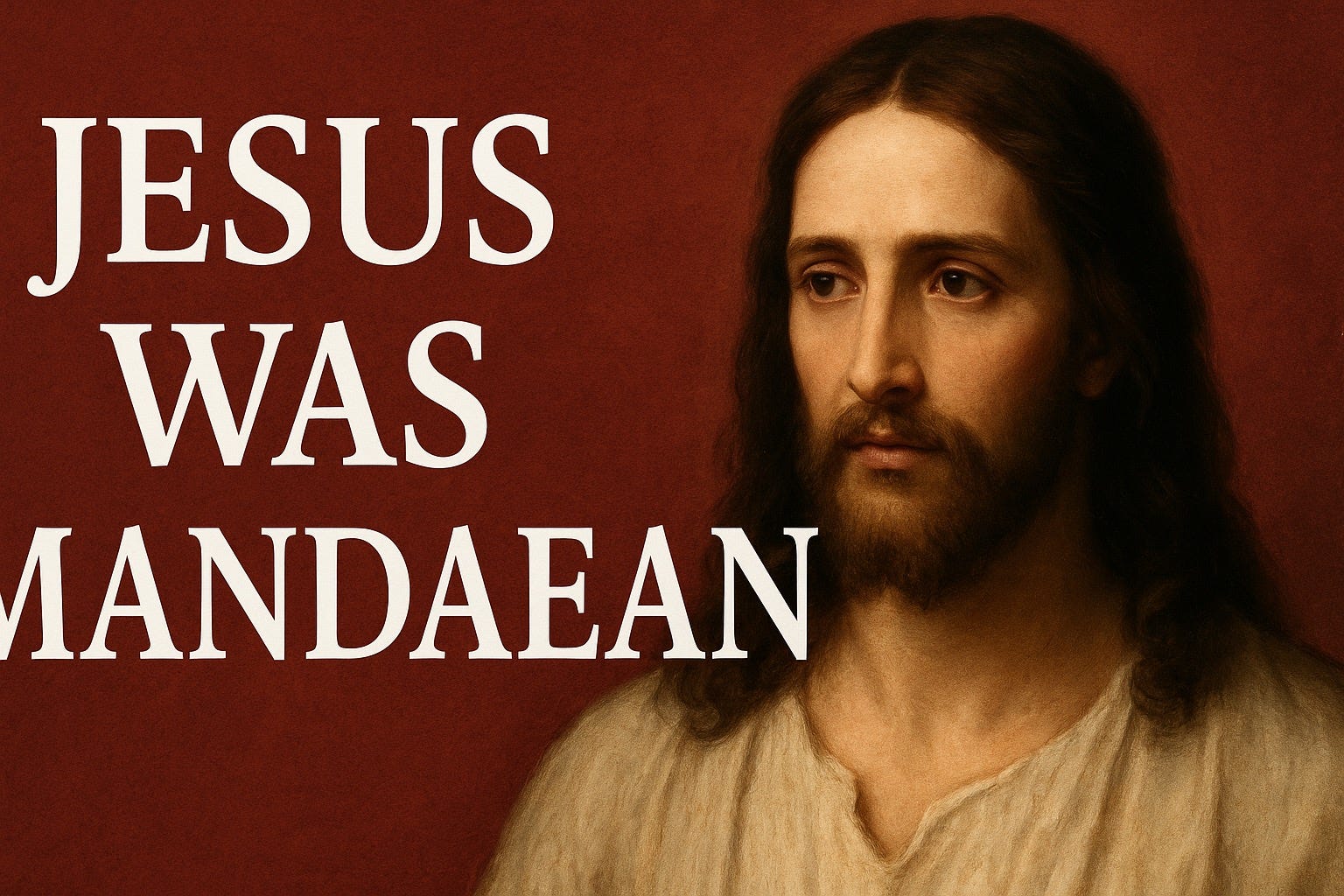
A comprehensive case
If proof means a signed confession in an ancient court then history rarely gives it. If proof means a cumulative case that explains more facts with fewer assumptions than any rival theory then this is that case. The simplest and most powerful explanation of the earliest evidence is that Jesus began in the current of John the Baptist and that current is the stream preserved by the Mandaeans. Jesus was Mandaean.
The starting point
Every strand of early tradition places Jesus under the baptism of John. That is an entry rite, not a casual visit. It signals allegiance, a hand on the plow. The Mandaean community, whose scriptures and ritual life center on Yahia Yohanna who is John, has preserved a living memory of a movement defined by running water, repeated immersion, purity of life, and instruction about Light and Life. The gospels try to move John off stage. History keeps pulling him back to the front.
The water and the hour
The movement of Jesus and the circle around him is bound to water. The Jordan. Springs and wadis. The Kidron stream that skirts the garden we know as Gethsemane. The earliest narrative includes a puzzling detail, a young follower who slips away at arrest leaving only a linen garment behind. That detail is a clue. Mandaeans immerse in living water while vested in white linen. They prize dawn rites and quiet hours before sunrise. The setting fits the practice. The cloth fits the practice. The secrecy of night fits the practice. You do not need invention here. You need only to see what is already on the page.
The language of Light
Jesus speaks with a vocabulary that is native to Mandaean thought. Birth from above. Birth of water and spirit. Light against darkness. Life that is from the Father not from the world. The Mandaean Book of John and the wider Mandaean liturgy speak the same grammar. There is overlap because there is shared soil. The later church turns that grammar into Greek philosophy and synagogue argument. The original cadence is closer to the rivers.
The enemy of sacrifice
Jesus confronts the traders and changers at the temple and overturns the tables. That is not a small gesture. It is a strike at the sacrificial engine of the cult. Mandaeans reject blood sacrifice outright. They do not bring animals to altars. They bring souls to water. Jesus stands with that rejection. He calls for mercy rather than sacrifice. He points away from the temple and toward the Father of Life. The move is the same move.
The hard saying in the court
There is a violent exchange recorded in which Jesus tells his accusers that their father is the liar from the beginning and a murderer. The point is not a theatrical insult. It is a theological judgment on the god of the temple system. The Mandaeans make the same judgment. Their scriptures name the god of the cult a dark power and deny that he is the Father. The alignment is exact on the point that matters most.
The hostile witness
The Book of John in Mandaic does not flatter Jesus. It calls him a deceiver. It accuses him of taking the name and the teaching of John. That is a gift to the historian. Hostile testimony is weighty because it has no reason to invent a connection that embarrasses the witness. If Jesus had been a stranger to the movement of John the Mandaean book could have ignored him. Instead it labors to define itself against him. That is the mark of proximity.
The woman who sees
Christian memory places Mary Magdalene at the empty tomb and gives her the first encounter with the risen Jesus. Mandaean memory tells of a Judean woman named Miriai who leaves the priests and comes to the way of Light. The names are not identical but the profile is striking. A woman who turns from the cult and stands for a new way. It is reasonable to see reflection here. It is also reasonable to see why a later polemic would keep Jesus down while keeping the figure of a woman who left the priests as a trophy. The overlap again points to a common stream with divergent tellings.
Why the synagogue record is thin
The rabbinic record does not preserve a clear biography of Jesus. That is sometimes used as an argument against his existence. It is better understood as evidence that he did not belong to the world that produced those records. He was not a scribe of Torah. He was not a court rabbi. He belonged to a river movement that had no seat in the halls of law. So the synagogue literature is mostly silent or hostile. Meanwhile the only group that preserves a sustained polemic is the group closest to John. The Mandaeans.
Why the imperial version looks different
Rome could not build a world religion on a river sect that rejects sacrifice and temple power. Rome needed continuity with ancient scripture and a story that binds the provinces. The imperial church fuses Jesus to the scrolls of the Temple Cult and brands him as fulfillment of law and prophets. The light language is re voiced into Greek concept speech. The community that formed around water is redirected toward altars and priests. This is why the earliest layers point to the river and why the later grandeur points to the basilica.
Counterpoints and answers
It is said that the Mandaean Book of John is late in the form we have. That is true of the redaction but it does not erase older material. Sectarian scriptures often crystallize over time while carrying very old stones inside their walls.
It is said that Miriai is not named Mary Magdalene. That is correct as a strict identity claim. The argument here is not that the text uses the same proper noun. The argument is that the role is the same and that parallel memory in a hostile book is powerful.
It is said that Jesus sounds Jewish in the gospels. That is because the gospels we have were written and edited inside a project that sought to place him within the scriptures of the Temple Cult. When you strip away those layers the water and the light remain. The river remains. The baptism remains. John remains.
The timeline that fits
A teacher emerges at the Jordan under John. The teacher gathers disciples in villages around springs and streams. The teacher contests the money cult at the temple at a festival. The teacher is arrested at night near water where initiates were present. The teacher is executed by Rome. The followers report encounters with the living teacher after death. The group continues with immersion and instruction. Polemics against the teacher appear in the scripture of the community that claims John as founder. Imperial theology rises that makes the teacher the emblem of a very different faith centered on scripture, altars, and later, empire.
What the case explains
This reading explains why the earliest tradition begins with baptism under John.
This reading explains why water and linen and dawn keep showing up around decisive scenes.
This reading explains why the polemic that survives outside the church is Mandaean rather than rabbinic.
This reading explains why Jesus clashes with sacrifice and calls for mercy and purity.
This reading explains why the later version must overlay the river story with synagogue and empire.
Verdict
You do not need a lost certificate to know where the path began. The water tells you. The linen tells you. The woman who sees tells you. The hostile book that tries to push him away tells you. The pieces form a single shape. Jesus was Mandaean.
veritas lux mea
Footnotes and sources
Flavius Josephus. Antiquities of the Jews. Book eighteen. English translations widely available.
Flavius Josephus. The Jewish War. Book six. English translations widely available.
Charles G Häberl and James F McGrath. The Mandaean Book of John. Brill. Critical edition with translation and commentary.
E S Drower. The Mandaeans of Iraq and Iran. Oxford. Classic field study with translations and ritual descriptions.
Jorunn J Buckley. The Mandaeans Ancient Texts and Modern People. Oxford University Press. Comprehensive survey of texts and practices.
Raymond E Brown. The Gospel According to John. Anchor Bible Commentary. Detailed discussion of language of light and layers in the text.
James D G Dunn. Jesus Remembered. Eerdmans. Historical Jesus within first century Jewish and post temple currents.
Paula Fredriksen. Jesus of Nazareth King of the Jews. Vintage. Historical framing of Jesus and the temple conflict.
Shimon Gibson. The Final Days of Jesus. A study of Jerusalem topography including water systems around the Kidron and Gethsemane.
John J Collins. Introduction to the Hebrew Bible. For the development of second temple religion and the temple centered system that Jesus confronted.
A very convincing argument and if I was a juror I would have definitely voted for Jesus being a Mandaean (I always leaned toward Buddhists) but he for sure was not a jew or a rabbi. Great article and leaves one with a lot of room for thought and resonation of what we have been fed to this day by false books and false teachers.
jesus is deciever
cause john was beheaded
as subject report of memory
and jesus is deciever
cause his birth
was not divine
as painter paints it systematically
and jesus is jew
cause he's sun is hollow
has no power of wisdom
rotting all rightfulness
jesus is deciever.